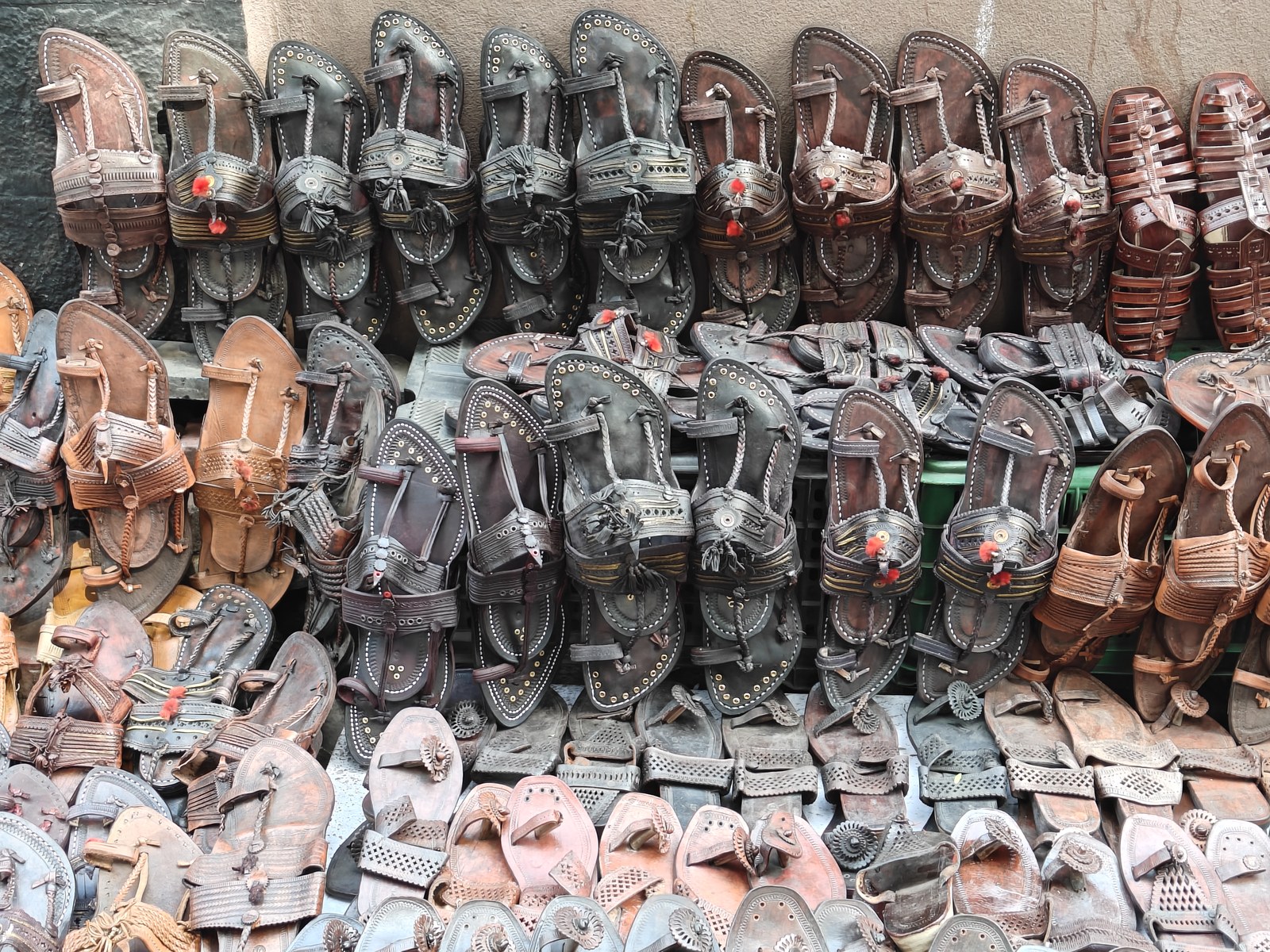
Photo: सुबोध कुलकर्णी / Wikimedia Commons, CC BY-SA 4.0
Kolhapuri Chappal
Vegetable-tanned leather sandals, hand-stitched without a single nail — a 13th-century craft still worn daily.
| GI number | GI-169 |
|---|---|
| Registered | |
| Goods class | 25 |
| Proprietor | LIDCOM & LIDKAR (Mah. & Kar.) |
| State | Maharashtra |
The story
Kolhapuris have been walking India since at least the 13th century — bath-tanned buffalo leather, cut, layered and stitched entirely by hand, with no nails and traditionally no synthetic adhesive. The 2019 GI is shared across districts of Maharashtra and Karnataka, an acknowledgement that the craft belongs to a belt of artisan communities, not a single town.
How it is made
- Buffalo/cow hide is vegetable-tanned in myrobalan and babul bark pits.
- Sole layers are cut, stacked and stitched with leather thongs.
- Uppers braided and punched with the signature patterns.
- Finished with natural oils; no nails, minimal adhesive.
◈ How to identify the authentic Kolhapuri Chappal
What to check
- Natural tan colour that darkens with wear — not painted uniform brown.
- Hand stitching with leather cord, visible and slightly irregular.
- Distinct vegetable-tanned smell; sole is layered hide, not rubber.
- GI hangtag from LIDCOM/LIDKAR-registered clusters.
Where to buy
Authorised producers for this recent registration are not yet listed in our dataset. Check the GI Journal entry for authorised users, and prefer government emporia and cooperatives in Maharashtra.
Registry record
Registry record: GI-169 · Registered 2019 · Proprietor: LIDCOM & LIDKAR (Mah. & Kar.)
Region and market
Kolhapuri chappals are made by cobbler communities in Kolhapur and nearby districts of Maharashtra and Karnataka, including Belagavi, Bagalkot and Dharwad. The footwear became a widely recognised Indian craft, and the GI, shared across the two states, reflects a production belt rather than a single town. Design variants include the traditional braided upper, closed-toe versions and modern, lighter soles.
Buying guide
Real Kolhapuris are made of vegetable-tanned leather with hand-stitched and braided details, and they darken and soften with wear. Check the sole for layered leather rather than moulded rubber, and look for hand stitching with leather thread, not machine seams. Buy from Kolhapur's Chappal Lane, cooperatives such as LIDCOM and LIDKAR, or certified retailers, and break in new pairs gradually to avoid blisters.
Care and fit
New Kolhapuris are stiff and may bite at first, so wear them for short periods and let the leather soften with your foot. Keep them dry, and if they get wet, dry them in shade and rub in a little natural oil. Choose a pair that leaves a finger's width behind the heel, since the leather stretches a little. Look for an inner stamp naming the maker or cooperative.
Frequently asked questions
What is the GI registration number of Kolhapuri Chappal?
This catalogue lists Kolhapuri Chappal as GI-169. Registration numbers should be confirmed against the official GI Journal before commercial use.
Where is Kolhapuri Chappal made?
Kolhapuri Chappal is produced in Maharashtra, in the manufactured category of this catalogue.
Can Kolhapuri Chappal legally be made outside Maharashtra?
No. GI protection means only producers within the notified region of Maharashtra may legally sell goods under the name “Kolhapuri Chappal”.
How can I tell if my Kolhapuri Chappal is authentic?
Check the registered proprietor against the official registry, buy from authorised producer cooperatives, and use the identification checklist on this page.