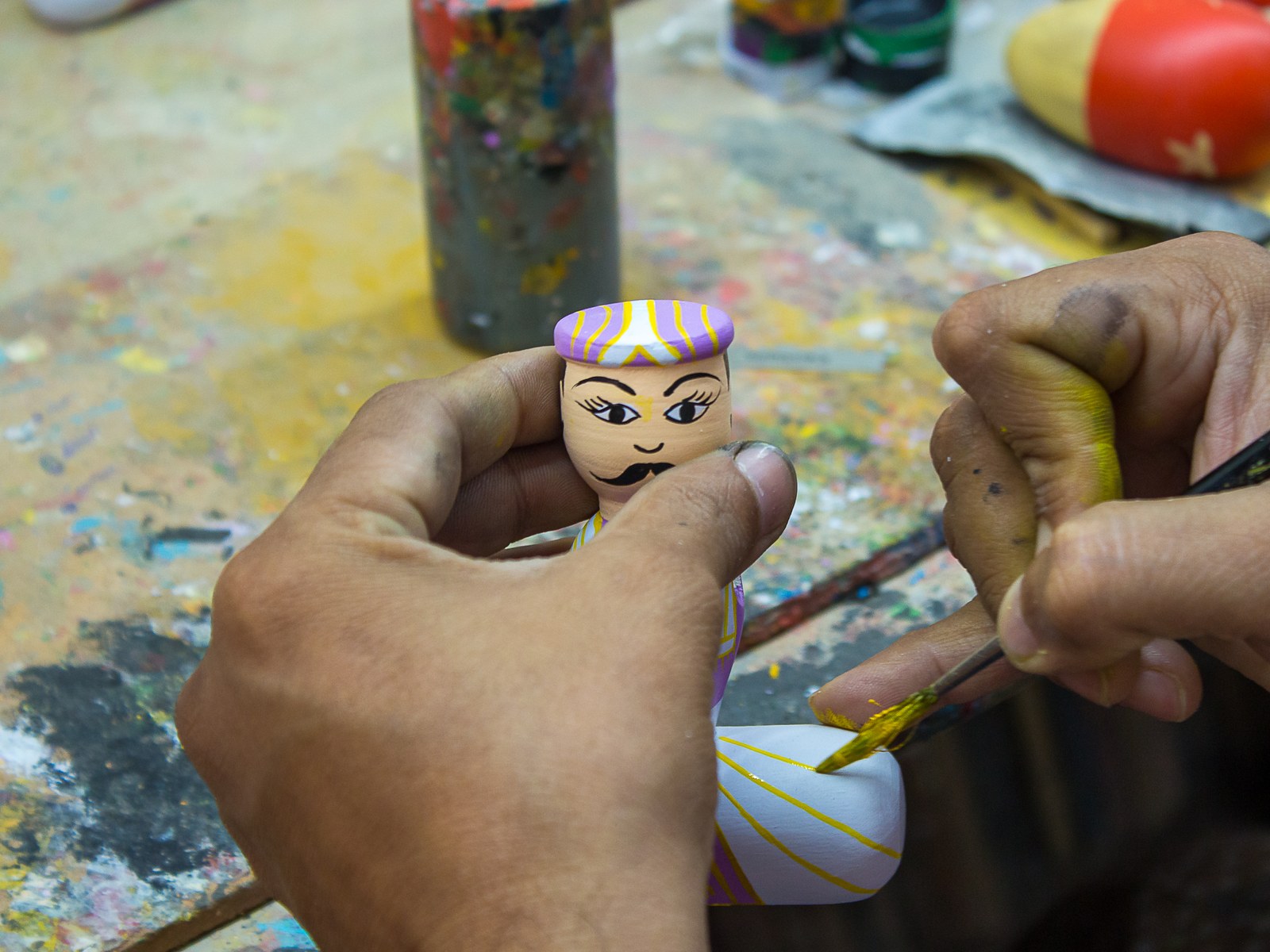
Photo: MaximusPrasad / Wikimedia Commons, CC BY-SA 4.0

Channapatna Toys
Lacquered wooden toys from 'Gombegala Ooru' (toy town), turned from ivory-wood and coloured with vegetable dyes.
| GI number | GI-16 |
|---|---|
| Registered | |
| Goods class | 28 |
| Typical price | ₹150 - ₹3,000 |
| Proprietor | Karnataka State Handicrafts Dev. Corp. |
| State | Karnataka |
The story
Tipu Sultan is said to have invited Persian artisans in the 18th century to train local craftsmen in lacquerware; two centuries later Channapatna, on the Bengaluru–Mysuru highway, is still 'toy town'. The toys are turned from soft Wrightia tinctoria (ale mara / ivory wood) and finished with natural lac and vegetable dyes — which is why they are safe for teething infants and beloved of design studios worldwide.
How it is made
- Ivory-wood is seasoned, cut and mounted on a lathe.
- The form is hand-turned — no moulds; every toy is subtly unique.
- Lac sticks mixed with vegetable dye are pressed against the spinning wood; friction melts the colour on.
- Polishing with dried screwpine leaf gives the signature soft gloss.
◈ How to identify the authentic Channapatna Toys
What to check
- Colours are muted-natural, never neon; finish is warm, not plasticky.
- No sharp edges or joints — forms are turned, whole and rounded.
- A faint lac smell; scratching never flakes paint (colour is fused, not coated).
- Buy from Cauvery emporia or GI-registered artisan cooperatives.
Crafted entirely from non-toxic ivory wood and lacquered using organic vegetable colors; fakes smell of pungent industrial chemical lacquers.
Price to expect
Genuine Channapatna Toys typically sells in the range of ₹150 - ₹3,000. Prices far below that range are a common sign of an imitation.
Where to buy
Look for authorised sellers such as Channapatna Crafts Park Artisan Union, or government emporia and cooperatives in Karnataka.
Registry record
Registry record: GI-16 · Registered 2006 · Proprietor: Karnataka State Handicrafts Dev. Corp.
Region and market
Channapatna's workshops sit along the Bengaluru-Mysuru highway, and the toy trade supports a large artisan community, including women's self-help groups who now work alongside traditional families. Product lines have expanded from rattles and tops to educational puzzles, stackers, jewellery and home decor. The craft's emphasis on natural lac and vegetable colours has helped it find a market with parents looking for safer wooden toys.
Buying guide
Buy from Cauvery Handicrafts emporia, cooperatives or artisan workshops that state the wood and finish used. Look for smooth, rounded edges, muted natural colours and a soft gloss, not a plastic sheen. Check that the paint does not rub off with a damp cloth. For very young children, choose larger pieces without small detachable parts, and keep the toys dry to prevent the wood from swelling.
Frequently asked questions
What is the GI registration number of Channapatna Toys?
This catalogue lists Channapatna Toys as GI-16. Registration numbers should be confirmed against the official GI Journal before commercial use.
Where is Channapatna Toys made?
Channapatna Toys is produced in Karnataka, in the handicrafts category of this catalogue.
Can Channapatna Toys legally be made outside Karnataka?
No. GI protection means only producers within the notified region of Karnataka may legally sell goods under the name “Channapatna Toys”.
What does genuine Channapatna Toys cost?
Genuine Channapatna Toys typically sells in the range of ₹150 - ₹3,000. Prices far below this range are a common sign of an imitation.
How can I spot a fake Channapatna Toys?
Crafted entirely from non-toxic ivory wood and lacquered using organic vegetable colors; fakes smell of pungent industrial chemical lacquers.
Where should I buy genuine Channapatna Toys?
Look for authorised sellers such as Channapatna Crafts Park Artisan Union, or government emporia and cooperatives in Karnataka.
From Karnataka and the handicrafts family
 Photo: Sumita Roy Dutta / CC BY-SA
Bidriware
Karnataka · ₹500 - ₹50,000
Ilkal Sarees
Karnataka · ₹2,000 - ₹20,000 Photo: Rajesh Nair from Bangalore, India / CC BY-SA
Aranmula Kannadi
Kerala · ₹3,000 - ₹1,50,000 Photo: Dcrjsr / CC BY-SA